Most Japan business visa problems for Indian applicants are not about eligibility. They come from small, avoidable gaps: the wrong visa category, the wrong VFS centre, a vague invitation letter, a missing NOC, or travel dates that don’t match across documents.
This guide by BTW Visa Services covers the most common Japan business visa problems Indian travellers face in 2026, and exactly how to fix each one before you submit.
What Is a Japan Business Visa?
It is a short-term (temporary visitor) visa for permitted business activities in Japan. Indian passport holders must get it before travel; there is no visa on arrival, and Japan’s eVisa for India covers short-term tourism only.
Permitted activities include:
- Business meetings and negotiations with Japanese clients
- Trade fairs, exhibitions and conferences
- Market research and exploring partnerships
- Contract signing and after-sales service discussions
The visa may allow a stay of 15, 30 or 90 days, depending on what is issued.
Important
A business visa does not allow paid work or revenue-generating activity in Japan. If you plan to work for, or run, a business in Japan, you need a different status (usually with a Certificate of Eligibility).
Common Japan Business Visa Problems (and How to Solve Them)
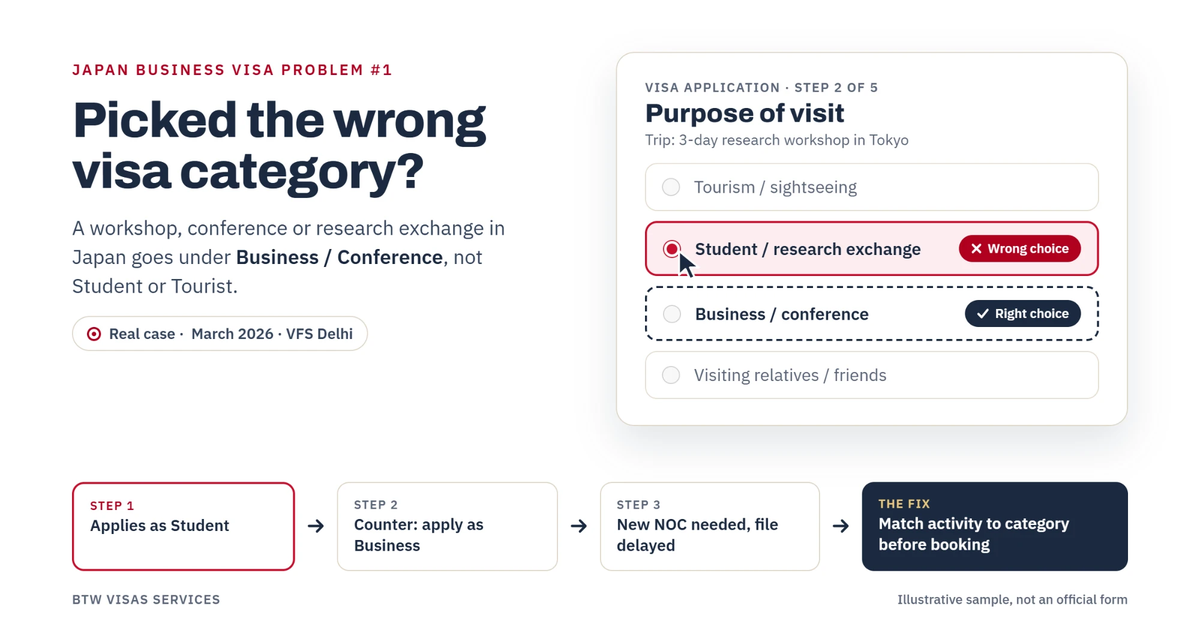
Problem 1: Applying under the wrong visa category
Real scenario (Reddit, March 2026): An Indian researcher going to Japan for a research exchange and workshop expected to apply under a student-related category. At VFS Delhi, they were told to apply under the business category instead. That triggered a new requirement: a No Objection Certificate (NOC) from their department, which they had to arrange before the application could go in.
Why it happens: Conferences, workshops, research exchanges and corporate training sit between tourist, student and business categories. In India, conferences fall under the “Business Affairs / Market Research / Conference” visa.
Solution:
- Match your activity to the category before booking an appointment. Meetings, conferences, workshops, exhibitions and market research = business category.
- Open the checklist for that category on your VFS centre’s page and list every employer document it asks for.
- Get the NOC or employer letter ready in advance, so a category change at the counter doesn’t send you home.
Problem 2: Applying at the wrong VFS centre (jurisdiction)
Common scenario: Your passport shows your hometown address in one state, but you work in another city. Japan’s missions in India accept applications only by jurisdiction, so the centre you choose matters.
For example, the VFS Kolkata business visa page asks for a work-from-home letter if your workplace is outside its jurisdiction (West Bengal, Bihar, Jharkhand, Odisha).
Solution:
- Check which Embassy/Consulate covers your current place of residence (Delhi, Mumbai, Chennai, Kolkata or Bengaluru).
- If your passport address differs, carry residence proof for your current city (rental agreement, utility bill).
- If your office is in another state, ask the VFS centre what extra letter it needs before you go.
Walk-in or appointment rules also differ by centre. See our Japan visa walk-in rules for India for the city-wise status.
Problem 3: No NOC or employer letter
Common scenario: A salaried employee applies with an invitation letter and bank statements, but no letter from their Indian employer. The file is stopped at the counter.
The VFS Kolkata page states that an NOC from the company is required for the business visa. Other centres ask for a letter from the employer or a travel order.
Solution: Get one letter on company letterhead, signed by HR or a manager, that states:
- Your name, designation and employment since (date)
- The purpose of the Japan trip and the Japanese company’s name
- Exact travel dates and approved leave/deputation
- Who pays for the trip
- That you will return to your job in India
Problem 4: The invitation letter is too vague
Common scenario: The Japanese partner sends a friendly email saying “please visit us in October.” That is not an invitation letter.
Japan’s official checklist asks for the details of activities planned in Japan and says vague descriptions are not accepted.
Solution: Send your Japanese contact the official Invitation Letter format and ask them to fill in:
- Specific purpose (e.g., “supplier quality review and price negotiation for FY27 contract”, not “business visit”)
- Background of the invitation and your business relationship
- Exact dates, matching your employer letter
- Contact person, phone and address in Japan
Problem 5: The Japanese company delays sending documents
Common scenario: Your meeting is fixed, but the Japanese side is slow to send the guarantee letter and company documents. Applicants often wait for couriered originals or a company seal.
What helps:
- Copies are accepted. Japan’s checklist says copies of documents prepared in Japan are accepted, though originals may be requested later (MOFA checklist). Ask for a clear scanned PDF.
- Seal is no longer required. MOFA’s visa page notes that a company or personal seal on the Letter of Guarantee and Invitation Letter is no longer required (MOFA). Tell your partner a signature is enough.
- Company proof: If the Japanese company pays, it provides a certified copy of its corporate register or a company overview. A company listed on a Japanese stock exchange may send its quarterly corporate report instead.
Share a ready list of required documents with your Japanese contact on day one, so they prepare everything in one go.
Problem 6: Confusion over who pays
The documents change depending on who pays for flights and stay. Decide this first.
| Who pays | What you typically need |
|---|---|
| Indian employer | Employer letter/travel order stating the company bears expenses, employment certificate |
| Japanese company | Letter of Guarantee + company register or overview from the Japanese side |
| Self-employed / business owner | Business registration, ITR, GST returns (if any), business bank statements, a cover letter explaining the commercial purpose |
Solution: State the same payer in the application form, employer letter, invitation letter and guarantee letter. Mixed answers lead to extra questions.
Problem 7: Dates and details don’t match across documents
Common scenario: The employer letter says 10–18 November, the invitation says 12–16 November, and the itinerary shows a weekend in Osaka not mentioned anywhere else.
Solution: Before submission, check that these match on every document:
- Name spelling exactly as on the passport
- Travel dates and length of stay
- Purpose of visit
- Japanese company name and address
- Who pays
If you plan leisure days, add them openly to the itinerary rather than hiding them.
Japan Business Visa Timing Problems: Delays and Bookings
Problem 8: The meeting date is close and the visa is still “under process”
The official benchmark is 5 working days from the day after the application is received, if nothing is wrong with it. If there is a problem, the file goes to the Ministry of Foreign Affairs in Tokyo and can take more than a month (MOFA).
Other delays applicants don’t expect:
- Additional documents restart the clock. VFS Kolkata states at least 5 more working days after you submit requested documents (VFS Kolkata).
- Some missions quote longer. VFS Mumbai’s page lists a minimum of 10 working days from submission at the Consulate in Mumbai (VFS Mumbai).
- No fast-track. An urgent meeting does not speed up processing.
Solution: work back from your meeting date.
| When | What to do |
|---|---|
| 6–8 weeks before | Confirm visa category and jurisdiction; send the document list to the Japanese company |
| 5–6 weeks before | Receive invitation/guarantee letters; get employer NOC/letter |
| 4–5 weeks before | Cross-check all documents; book VFS appointment |
| 3–4 weeks before | Submit at VFS; track online |
| After approval | Book non-refundable flights and hotels |
If the visa is still pending close to departure, keep tracking through VFS, respond quickly to any request, and agree a backup date or video-call option with your Japanese partner.
Problem 9: Non-refundable bookings made before approval
Real scenario (Reddit, February 2026): An Indian applicant was refused a Japan tourist visa despite submitting extensive documents. They had already paid for flights and hotels, and after the refusal could recover only partial refunds from the airline and hotel.
The same risk applies to business trips, and a refusal blocks a same-purpose reapplication for six months (see below).
Solution:
- Use a flight reservation/itinerary or a refundable fare for the application.
- Book hotels with free cancellation.
- Pay for non-refundable bookings only after the visa is in your passport.
- If the company books travel, ask the travel desk to hold, not ticket.
Problem 10: Applying again and again for every trip
Common scenario: A sales or engineering employee visits Japanese clients three or four times a year and files a fresh single-entry application each time, with a new invitation letter and NOC every time.
Solution: Check whether you qualify for a multiple-entry business visa. According to the VFS Japan India page, eligible business applicants include:
- Employees of a company listed on a stock exchange (in Japan, India or a third country)
- Regular employees of a Japanese-affiliated company that is a member of the Japan Chamber of Commerce and has a management base in Japan
- Regular employees of a joint venture, subsidiary or branch of a listed company
- Regular employees with a business trip to Japan plus visits to G7 countries in the last three years
- Regular employees with more than three business trips to Japan in the last three years
The first visit must be for business. From the second visit, it can also be used for tourism or visiting acquaintances, but never for paid work.
Problem 11: Japan business visa refused. What now?
Japan does not tell applicants why a visa was refused, and it will not accept a new application for the same purpose within six months of the refusal (MOFA FAQ).
Mistakes to avoid:
- Switching city or centre. Refusal records are shared across missions in India, so applying from another city does not help.
- Resubmitting the same file. Without fixing the weak points, the result is likely to repeat.
- Hiding the refusal. The application form asks about previous refusals. Answer truthfully.
What to do:
- Review your file against the Japan business visa problems above: category, jurisdiction, invitation detail, payer, date consistency.
- Inform your Japanese partner early; move the meeting online or to a later date.
- Before the next application, get a professional review of the full file.
Documents Required
The exact list depends on your jurisdiction and who pays. Always use the latest checklist on your VFS centre’s page.
| Document | Prepared by | Note |
|---|---|---|
| Valid passport | Applicant | Machine-readable, with blank pages |
| Visa application form + photo | Applicant | Photo to Japan visa specifications |
| Employer NOC / letter / travel order | Indian employer | Dates, purpose, payer, return to job |
| Employment certificate or business proof | Applicant / employer | Business registration if self-employed |
| Financial documents | Applicant | Where you pay your own expenses |
| Invitation letter | Japanese company | Official format, specific activities |
| Itinerary in Japan (schedule of stay) | Japanese company | Must match all other dates |
| List of visa applicants | Japanese company | Only if more than one applicant |
| Letter of Guarantee | Japanese company | Only if it pays your expenses |
| Company register or overview | Japanese company | Only if it pays; listed firms may send a quarterly report |
Fees
The Japanese consular fee for Indian nationals is ₹500 for both single- and multiple-entry visas. A VFS service charge is added on top. Fees can change, so confirm on the VFS page before paying.
Pre-Submission Checklist to Avoid Japan Business Visa Problems
- ☐ Activity matches the business/conference category
- ☐ Applying at the centre that covers my current residence
- ☐ Employer NOC/letter states dates, purpose, payer and return
- ☐ Invitation letter is in the official format with specific activities
- ☐ Guarantee letter and company proof attached (if the Japanese side pays)
- ☐ Name, dates, purpose and payer match on every document
- ☐ Documents arranged in the order of the VFS checklist
- ☐ Only refundable or held bookings made so far
- ☐ Submitting at least 3–4 weeks before the meeting
How BTW Visa Services Can Help
We review your file for the exact Japan business visa problems in this guide before you submit: category, jurisdiction, invitation wording, employer letters, payer details and date consistency. We also share the official formats with your Japanese partner so their documents arrive right the first time.
Conclusion
Most Japan business visa problems, including refusals and delays, start with avoidable gaps, not weak profiles. Choose the right category and centre, get specific documents from both sides, keep every detail consistent, and give yourself 3–4 weeks of buffer.
Planning a business trip to Japan?
Contact BTW Visa Services for a document review before you apply. See also our full Japan business visa guide.
Email corporate@btwvisas.com | 9403460643 | WhatsApp
Disclaimer
This article is for general information only. Visa rules, fees, processing times and document requirements may change. Final decisions are made solely by the Japanese authorities. BTW Visa Services does not guarantee visa approval or a specific processing time.
Sources
- MOFA – Visa application checklist (short-term stay)
- MOFA – Visa information and forms
- MOFA – Processing time
- MOFA – Visa FAQ (reapplication rule)
- VFS Global – Japan, Kolkata
- VFS Global – Japan, Mumbai
- VFS Global – Japan, Delhi (multiple-entry eligibility)